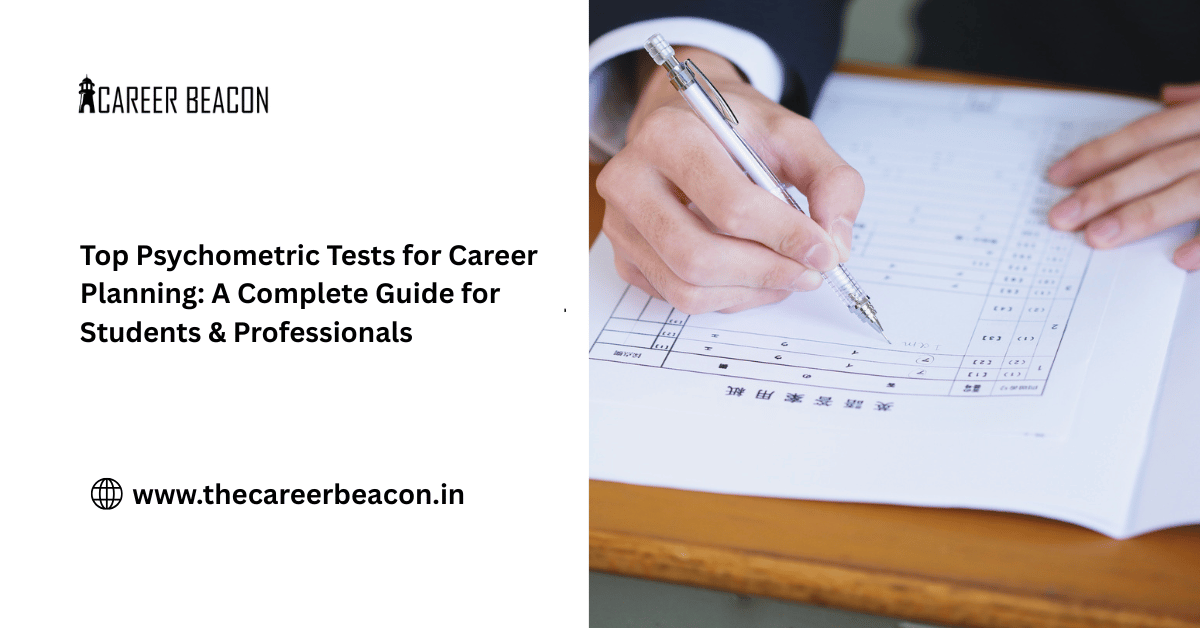
People see more options for jobs now than ever before and that makes it difficult to know where to begin your career search. Due to the vast number of careers listed each year and how careers that were once traditional have changed to keep up with the times, many students are finding it hard to choose what they would like to do after high school or college. When choosing a career many students question themselves with thoughts like “What career fits my personality?” or “What am I good at?” or “Will I be successful at this job?” This is where Psychometric Tests come into play. Psychometric Tests offer a scientific way for people to identify their strengths, skills, interests, and personality so that they can make confident and informed decisions regarding their career paths.
Career Counsellors, universities, and businesses from all over the world use Psychometric Testing for the very reason that it is a reliable and unbiased way to identify one’s potential. Unlike traditional measures of intelligence and grades, Psychometric Testing does not focus on the score achieved by the individual being tested. Psychometric Tests are designed to give people an insight into how they think, how they act, what motivates them, and which careers would fit their natural capabilities. Properly interpreted Psychometric Test results will allow the individual to rethink their entire educational and career paths.
Why Psychometric Tests Matter in Career Planning
Most students choose a career based on marks, parental pressure, peer influence, or assumptions. But a career chosen without understanding your natural strengths often leads to dissatisfaction or burnout. Psychometric tests eliminate guesswork and bring clarity by offering a scientific explanation of your personality, aptitude, and interests.
These tests help students understand themselves better, boost confidence in choosing a stream or course, and reduce the confusion that comes with too many options. For young professionals, psychometric tests give insights into work style, leadership potential, and long-term career fit—helping them make smarter career transitions.
Why Psychometric Tests Matter in Career Planning
Most students choose a career based on marks, parental pressure, peer influence, or assumptions. But a career chosen without understanding your natural strengths often leads to dissatisfaction or burnout. Psychometric tests eliminate guesswork and bring clarity by offering a scientific explanation of your personality, aptitude, and interests.
These tests help students understand themselves better, boost confidence in choosing a stream or course, and reduce the confusion that comes with too many options. For young professionals, psychometric tests give insights into work style, leadership potential, and long-term career fit—helping them make smarter career transitions.
Top Psychometric Tests Used for Career Planning
Below are some of the most trusted and widely used psychometric assessments that help students find the right direction.
1. DiSC Profile Assessment
The DiSC Profile assessment is one of the world’s most widespread personality assessments. The DiSC categorizes people into 4 primary personality types (D, I, S & C) by analyzing the way that a person thinks and processes information, makes decisions, interacts with others, and responds to their environment. For those who know their DiSC Profile type, it provides an opportunity to identify careers that match your natural tendencies, whether they tend to be analytical, creative, logical, empathic, introverted and / or extroverted. Many students wishing to investigate and pursue specific career fields use the DiSC Profile assessment to explore various areas of study such as business management, psychology, engineering, media, design and public service.
2. Holland Code Career Test (RIASEC)
This test helps students identify what careers they want to pursue (their interests) and find out which types of careers will keep them motivated for the long term by categorizing individuals into six primary categories: Realistic, Investigative, Artistic, Social, Enterprising, and Conventional. If you know where you fit in each of these categories, you will be able to understand better what kind of job and working environment motivates you in the long run. In India, the RIASEC model is popular among Class XI/Class XII students exploring postsecondary (above Class XII) options.
3. Multiple Intelligence (MI) Test
The MI Test is based on Howard Gardner’s (1983) theory of multiple intelligences and determines the different types of intelligence that you possess based on the areas of linguistic (word), logic-mathematics (numbers), interpersonal (social), intrapersonal (self), musical, and spatial. This test is useful for school students who are trying to choose their subjects in Class XI or are trying to decide what path they want to take after completing Class XII, either Science, Commerce or Humanities, because the MI test identifies your best areas of natural ability, which are usually not captured by traditional testing.
4. Aptitude Tests
Aptitude tests measure your ability to learn naturally through various means including your aptitude for solving problems, analyzing a situation and understanding numbers, language comprehension and visualisation. Aptitude tests are one of the most important criteria for Career Planning as they measure a person’s potential or ability to perform certain functions. A student who scores well in Numerical Reasoning may find that Careers in Finance or Engineering are a good fit for them while someone who scores well in Verbal Reasoning, may do well in Law, Journalism, or Education.Aptitude Tests are the main foundation upon which Science-Based Career Development is built.
5. Big 5 Personality Assessment (OCEAN Model)
The Big 5 Personality Test is one of the most reliable and factual Scientific assessments of a person’s character. It determines a person’s personality using five key personal characteristics: Openness, Conscientiousness, Extraversion, Agreeability, and Emotional Stability. These characteristics can help or impede the way an individual performs, reacts to Stress, interacts with others in Teamwork situations, takes responsibility for their own actions and has a clear path toward Career Success. As a tool for Students and Working Professionals, it is especially helpful for those Transitioning into Leadership and Communication Positions or those pursuing careers that require Creative Thinking.
6. Emotional Intelligence (EQ) Assessment
Emotional intelligence has become one of the most valued skills for future careers. EQ tests evaluate your ability to understand and manage emotions, communicate effectively, show empathy, and handle conflict. Careers in hospitality, management, healthcare, teaching, leadership, HR and public relations often require high emotional intelligence. For students preparing for people-oriented roles, EQ testing provides deeper insight into strengths they can build on.
How Psychometric Tests Improve Career Decisions
The true power of psychometric assessments lies in self-awareness. When students understand what they are naturally good at—and what truly interests them—they make more confident and informed choices. They are less likely to switch courses later, feel overwhelmed in college, or regret their decisions.
Moreover, psychometric tests help career counsellors build a personalised roadmap for each student. Based on the results, counsellors can suggest suitable streams, subjects, career paths, professional courses, skill development programmes, and even colleges or job roles.
For young professionals, these tests help identify leadership potential, ideal work culture, communication style, and areas for improvement—making career transitions easier and more strategic.