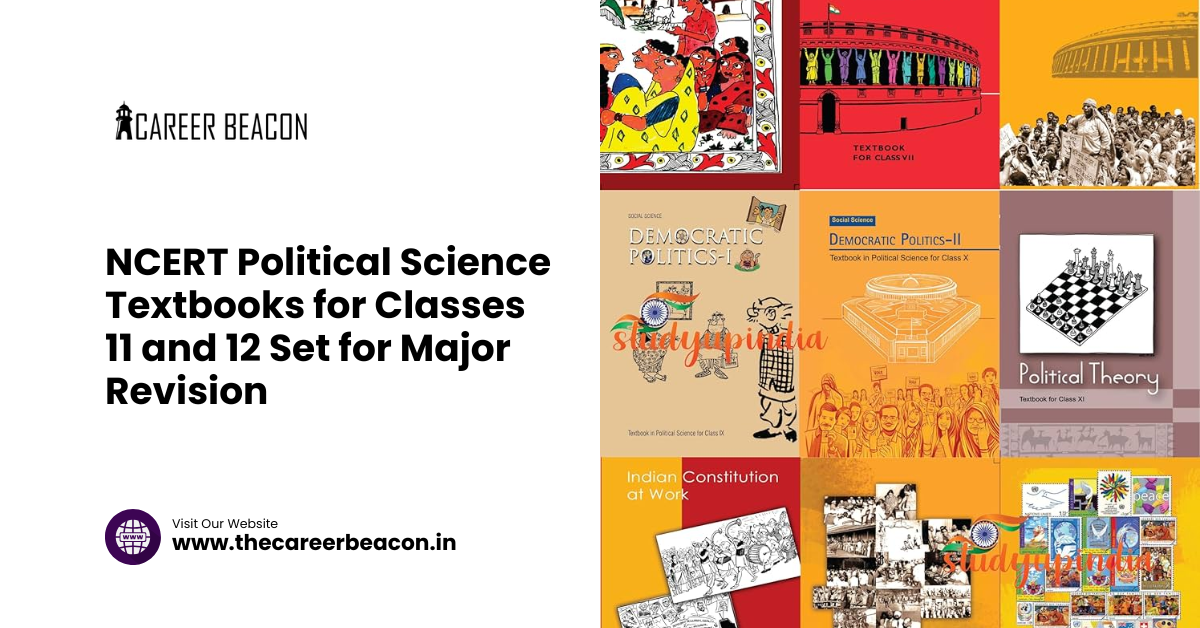
The NCERT Political Science textbooks for Classes 11 and 12 are in urgent need of a major revision and the National Council of Educational Research and Training (NCERT) has reconstituted a 20-member team to prepare new textbooks and teaching-learning material. The move is part of continued implementation of National Education Policy (NEP) 2020 and National Curriculum Framework for School Education (NCF-SE) 2023.
The revision could be significant for senior secondary students, especially those preparing for board exams and looking to pursue political science, law, public policy, civil services or related fields. The new approach is likely to focus more on cultural rootedness, Indian knowledge systems and inclusion while aligning textbooks to the revised curriculum framework.
Why Is NCERT Revising Political Science Textbooks?
NCERT has been gradually updating school textbooks following the introduction of NEP 2020. The policy aims to make education more flexible, relevant and focused on conceptual understanding rather than rote learning.
The revision of Political Science books is part of this larger process. Instead of simply changing chapters, the exercise is expected to look at how political concepts are presented to senior secondary students.
A Focus on Better Understanding
Political Science studies various concepts such as democracy, constitutional institutions, citizenship, political systems, and governance. Such subjects are useful for understanding theories and relating them to practice.
Revised textbooks can, therefore, provide many case studies and explanations of political theories instead of focusing on definitions alone.
This approach may be useful to students who would like to develop their analytical and communication abilities.
A 20-Member Panel Will Prepare the New Books
NCERT has constituted a 20-member Textbook Development Team for the Political Science Textbooks of Class 11 and Class 12.
The team comprises academicians, school teachers and faculty members of NCERT. Sandeep Shastri has been appointed as chairperson of the textbook development team.
Having people from different academic backgrounds can help the new books balance subject knowledge with the learning needs of school students.
The Revision Will Take Time
The textbook preparation process will involve drafting and reviewing the content before the final books are released.
Reports indicate that the first of the two textbooks is expected to be completed by November. However, students should wait for official NCERT announcements regarding the final publication schedule.
The exact chapter-wise changes are also not yet clear.
What Could Change in the New Political Science Books?
The final content will become clear only when NCERT publishes the revised textbooks. However, the broader direction of the exercise has already attracted attention.
One important area is cultural rootedness and the Indian knowledge system. The new textbooks are expected to include greater attention to Indian contexts while also maintaining an inclusive approach.
More Indian Examples Could Make Concepts Easier
Students can find the ideas they are learning in political science to be quite disconnected and impersonal due to its abstract nature. Linking the political concepts with different examples taken from real life could be helpful in understanding even the most complex ideas and theories.
In this regard, concepts relating to democracy, governance and citizenship can be explained with the help of different situations from the students’ environment and their peer interactions.
This could make the subject more appealing and easier to comprehend for students and understand how institutions impact their daily life.
At the same time, a good textbook should enable students to assess various viewpoints and form their own independent opinion on the issue.
What Does This Mean for Class 11 and 12 Students?
For students currently preparing for their examinations, there is no reason to panic.
The existing syllabus and textbooks should continue to be followed until NCERT or the relevant education board officially announces changes for a particular academic session.
Students Should Avoid Unofficial Updates
Whenever NCERT announces a textbook revision, social media platforms often fill with claims about deleted chapters, new topics and changed examination patterns.
Students should be careful with such information.
The safest approach is to rely on official NCERT announcements and the instructions issued by schools and education boards.
This is especially important for students preparing for board examinations.
NEP 2020 Is Behind the Larger Textbook Reform
The Political Science revision is not an isolated change.
NCERT has been developing new textbooks across different grades as part of the implementation of NEP 2020 and NCF-SE 2023. Revised books for lower classes have already been introduced, while higher classes are being covered gradually.
The Aim Is to Modernise School Learning
NEP 2020 places greater emphasis on conceptual understanding, multidisciplinary learning, skills and the connection between education and real life.
The new Political Science books are expected to reflect these broader objectives.
For students, this could mean learning political concepts in a way that connects more closely with society, institutions and current realities.
Why Political Science Still Matters for Future Careers
Political Science is often associated with civil services and teaching, but its career relevance is much wider.
Students can use the subject as a foundation for fields such as law, public policy, journalism, international relations, research and administration.
Skills Can Be More Important Than the Subject Alone
Studying Political Science can help students develop critical thinking, research ability, communication and argument-building skills.
These skills can be useful across many career paths.
Students planning their future after Class 12 should therefore look beyond the subject name and understand how their interests can connect with different academic and professional opportunities.
This is where career planning can help students make more informed choices.
What Should Students Do Next?
Students do not need to change their study strategy simply because NCERT is revising the textbooks.
The best approach is to continue preparing according to the syllabus prescribed for the current academic session.
Focus on Concepts
Students should focus on understanding important political ideas rather than depending entirely on memorised answers.
This can make preparation more useful even when textbooks are eventually updated.
Students should also keep checking official NCERT notifications for information about the release of new books and any changes that could affect their academic session.
Key Takeaways
NCERT Is Revising Political Science Textbooks
A 20-member panel has been formed to prepare new Political Science textbooks for Classes 11 and 12.
NEP 2020 Is Driving the Change
The revision is part of the wider implementation of NEP 2020 and NCF-SE 2023.
Indian Context Could Receive Greater Attention
The new textbooks are expected to focus more on cultural rootedness, Indian knowledge systems and inclusive learning.
Students Should Wait for Official Information
The final chapters, syllabus changes and publication timeline should be confirmed through official NCERT announcements.
FAQs
Are NCERT Class 11 and 12 Political Science textbooks being revised?
Yes. NCERT has formed a 20-member team to prepare revised Political Science textbooks and learning material for Classes 11 and 12.
Why is NCERT changing the Political Science books?
The revision is part of the wider textbook reform under NEP 2020 and NCF-SE 2023. The aim is to align learning material with the updated curriculum framework.
Will the new books affect current board students?
Students should continue following the syllabus and textbooks prescribed for their current academic session. Any changes will be communicated through official channels.
What careers can students pursue after studying Political Science?
Political Science can lead to areas such as law, civil services, public policy, journalism, research, international relations and administration.
Conclusion
The upcoming revision of NCERT Political Science textbooks for Classes 11 and 12 is another major step in the ongoing transformation of India’s school education system.
The 20-member panel will now work on developing textbooks that align with NEP 2020 and NCF-SE 2023. Greater attention to Indian contexts, cultural rootedness and conceptual learning could shape how senior secondary students study Political Science in the coming years.
For now, students should not rely on rumours about new or deleted chapters. They should continue with their existing syllabus and wait for official NCERT updates.
More importantly, students can use Political Science to develop skills that extend beyond examinations. Strong reasoning, communication and analytical thinking can support future academic and career decisions.
For students looking for guidance on career planning, higher education, college selection and career options after Class 12, thecareerbeacon can help them make more informed choices about their next step.