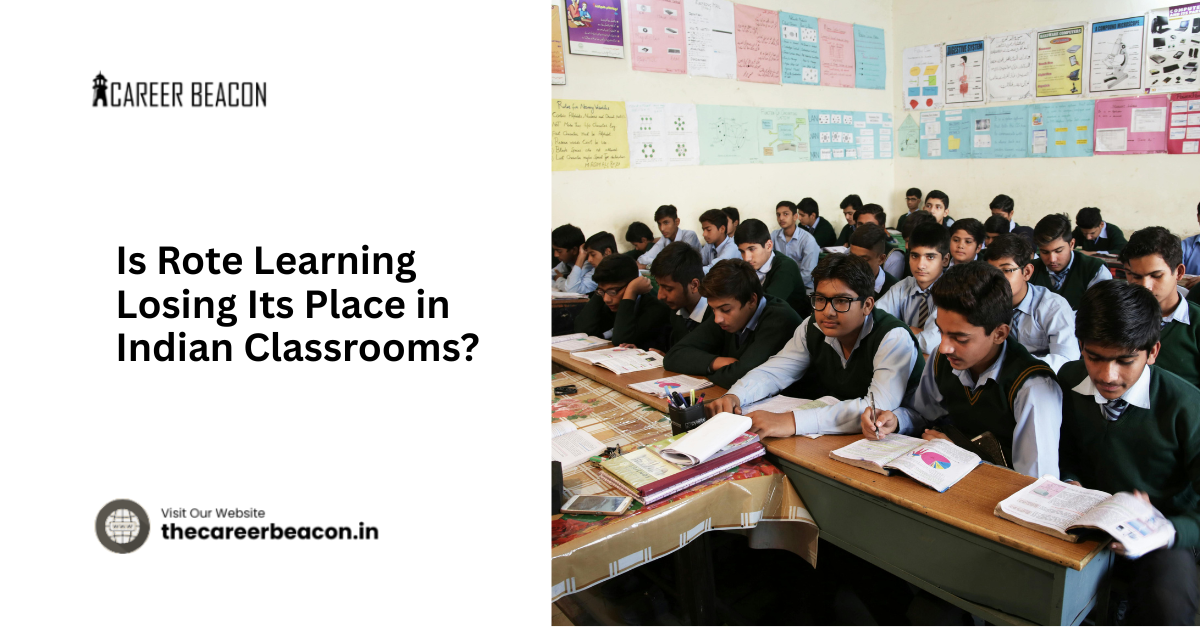
For decades, rote learning in India has been closely linked with school and college education. Students have often been encouraged to memorise textbook answers, important definitions and exam-related information to score well. However, the Indian education system is gradually moving towards a different approach. With greater attention on critical thinking, creativity, practical knowledge and skill development, memorising information is no longer the only measure of learning. The shift is also connected with the broader changes introduced through the National Education Policy (NEP) 2020. As classrooms become more focused on understanding and application, an important question is emerging: Is rote learning finally losing its place in Indian classrooms?
Why Has Rote Learning Been So Common in India?
Rote learning became popular because the education system traditionally placed strong emphasis on examinations and marks. When students had to prepare for tests based largely on textbooks and fixed syllabi, memorising information often appeared to be the easiest way to perform well. Teachers also faced large classrooms, limited time and pressure to complete the syllabus, making memorisation a practical method for covering large amounts of information.
For many students, this approach helped them remember formulas, dates, definitions and basic concepts. Memorisation itself is not always harmful because certain types of knowledge require repetition. The problem occurs when students remember information without understanding how or why it works. A student may reproduce an answer perfectly in an examination but struggle to apply the same concept outside the classroom.
Indian Education Is Moving Towards Understanding
The idea of learning is gradually changing from simply remembering information to understanding and applying it. Modern education places greater value on skills such as problem-solving, communication, collaboration, creativity and critical thinking.
The National Education Policy 2020 also promotes competency-based education and encourages learning that goes beyond memorisation. It focuses on conceptual understanding, experiential learning and developing students’ broader abilities. This represents an important shift in the Indian education system, where academic success is increasingly being connected with what students can actually understand and do.
Practical Learning Is Becoming More Important
One of the clearest alternatives to rote learning is practical education. Instead of only reading about a concept, students can understand it through experiments, projects, discussions, activities and real-world examples.
For example, a science student can learn about pollution by conducting a local environmental project instead of simply memorising definitions. A commerce student can understand financial concepts by creating a basic household budget. Similarly, a computer science student can develop a small application rather than only studying programming theory.
This approach can make lessons more meaningful because students can see how classroom knowledge connects with everyday life and future careers.
Technology Is Also Changing How Students Learn
Technology and artificial intelligence are adding another layer to this transformation. Students now have access to digital learning platforms, educational videos, simulations and AI-powered tools that can explain difficult concepts in different ways.
This means students do not necessarily need to depend only on memorising textbook answers. They can explore a topic, ask questions, compare explanations and practise concepts interactively.
However, technology does not automatically eliminate rote learning. Students can also misuse digital tools by copying answers without understanding them. The real benefit comes when technology encourages curiosity and deeper learning rather than becoming another shortcut for completing homework.
Does Rote Learning Have No Value?
Rote learning should not be completely dismissed. Memorisation has a useful role in education. Students need to remember multiplication tables, vocabulary, formulas, basic scientific facts and other foundational information.
The bigger issue is how much education depends on memorisation. Remembering basic information can provide a foundation, but students also need opportunities to analyse, question and apply that information.
For example, memorising a mathematical formula is useful, but understanding when and why to use it is more important. Similarly, remembering historical dates can help students build a timeline, but understanding the causes and consequences of historical events develops deeper knowledge.
The goal, therefore, should not be to eliminate memorisation completely. It should be to create a better balance between knowledge and understanding.
What Could Classrooms Look Like in the Future?
Indian classrooms are likely to become more interactive as education continues to focus on skills and competencies. Students may spend more time working on projects, solving problems, participating in discussions and applying concepts to real-world situations.
Teachers will also have an important role in this transition. Instead of simply delivering information, teachers can increasingly act as mentors who guide students towards understanding, questioning and independent learning.
Assessment could change as well. If schools focus more on practical knowledge, examinations may gradually place greater emphasis on application rather than simply asking students to reproduce memorised answers.
Conclusion
Rote learning in India is not disappearing overnight, but its role is gradually changing. Memorisation will continue to be useful for building foundational knowledge, but it cannot be the complete definition of learning.
As Indian education moves towards practical, competency-based and skill-focused approaches, students will increasingly need to understand concepts rather than simply remember them. The future classroom is likely to value curiosity, critical thinking, creativity and real-world application alongside academic knowledge.
For students, the message is simple: do not just learn an answer; understand the idea behind it. That shift can make education more useful not only for examinations but also for higher studies, careers and everyday life.