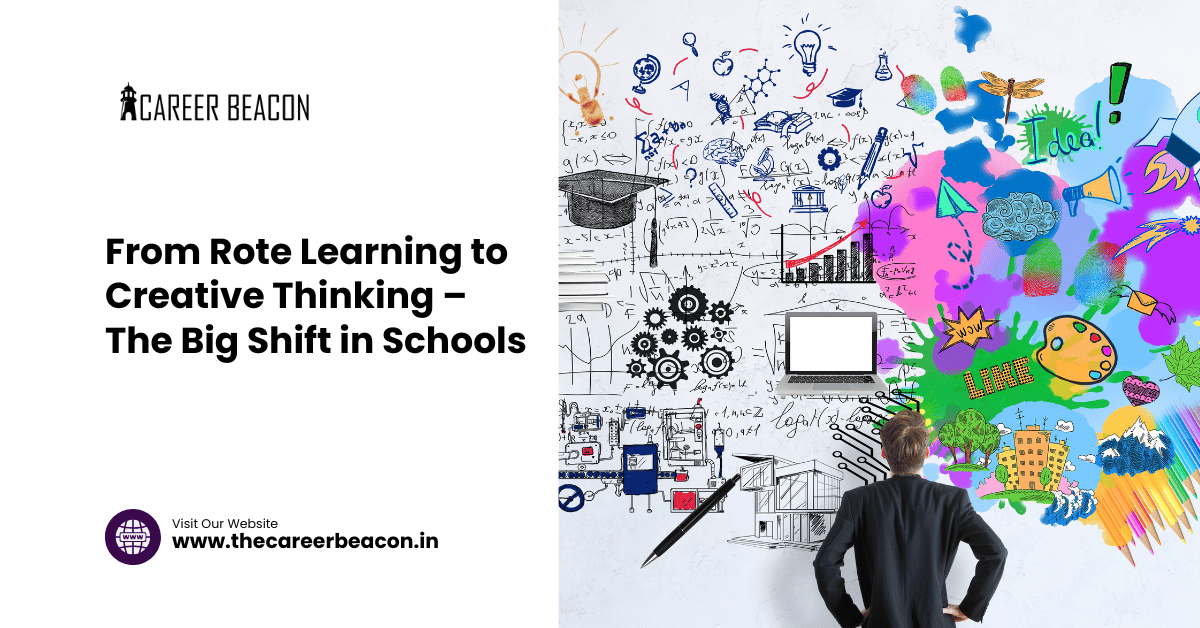
For many years, schools around the world used rote learning – that is, memorizing information and formulas without understanding what they meant. Schools prepared students to reproduce facts rather than apply them. Today, however, education is beginning to shift and there is a movement away from rote learning towards creative thought because the future needs innovators, problem-solvers and critical thinkers.
In this month’s issue, TheCareerBeacon examines how this shift in education will help students think independently and prepare them for a new world that is changing quickly.
The Problem with Rote Learning
Rote learning might help students score high marks in exams, but it limits curiosity and creativity. When students focus only on memorizing answers, they fail to grasp deeper concepts or apply knowledge in real-life situations.
Here’s what rote learning often leads to:
-
Short-term memory retention instead of deep understanding
-
Lack of innovation and original thinking
-
Fear of failure or experimentation
-
Minimal engagement and low motivation in classrooms
In a world driven by technology and creativity, these limitations are no longer acceptable. Students need to think beyond the textbook.
Why Creative Thinking Matters in Modern Education
The capacity to come up with original ideas, perceive several possible answers, and use creativity when solving problems is known as creative thinking. It’s for leaders, scientists, engineers, and businesspeople, not simply artists.
When educational institutions foster creativity, they:
- Promote inquiry and discovery
- Develop your ability to adapt and be creative.
- Encourage kids to confidently voice their thoughts.
- Encourage cooperation and empathy by working together.
Today’s employers look for applicants who possess critical thinking, creativity, and adaptability—skills that rote learning will never impart. Career advancement and ongoing learning are increasingly based on creative thinking.
How Schools Are Embracing the Shift
Across India and the world, schools are reimagining teaching methods to promote creativity over memorization. The National Education Policy (NEP) 2020 has played a major role in driving this change. It encourages experiential learning, multidisciplinary education, and flexible curricula.
Some key changes include:
-
Activity-based learning: Students learn through experiments, projects, and group discussions.
-
Concept-based assessment: Exams now test understanding, not just recall.
-
Project-based education: Students apply knowledge to real-world problems.
-
Technology integration: AI tools, virtual labs, and interactive simulations make learning engaging.
This approach helps students learn by doing, not by memorizing.
The Role of Teachers in Fostering Creativity
Educators are no longer only providers of knowledge, they are mentors and facilitators. Modern teachers ignite curiosity, facilitate research, and invite students to think openly.
Some effective strategies in the classroom include:
- Asking open-ended questions
- Getting them to brainstorm and debate
- Allowing flexibility in projects and assignments
- Making feedback constructive instead of rote grades
In this way, teachers are fostering a learning environment where students critically solve problems creatively and express their thinking.
Technology as a Catalyst for Creative Learning
Digital tools are making classrooms more interactive than ever. Platforms like AI-based learning assistants, virtual reality simulations, and gamified learning apps allow students to explore, create, and collaborate.
For example:
-
AI Tutors personalize lessons based on student performance.
-
3D Models and AR apps help visualize complex concepts.
-
Collaborative platforms like Google Classroom and Canva encourage teamwork and creativity.
The digital shift is helping schools move away from standardized teaching toward personalized, creative education.
Benefits for Students and Future Careers
The shift to creative thinking doesn’t just improve classroom performance—it prepares students for success in the real world.
Key benefits include:
-
Enhanced problem-solving and decision-making skills
-
Improved communication and teamwork abilities
-
Greater innovation and leadership potential
-
Stronger adaptability in changing industries
As industries evolve, career growth will depend more on creative intelligence than memorized knowledge. That’s why nurturing creativity early is vital for long-term success.

 How to Prepare for TCS NQT, Infosys and Wipro Elite 2027October 25, 2026
 AI Engineering Jobs in India: Skills You Need for Rs 1 Crore PayOctober 24, 2026
 Career Skills for Students in 2027: What Employers WantOctober 24, 2026
 Workflow Automation & LLMOps: Automating Routine Business Tasks in 2026October 20, 2026