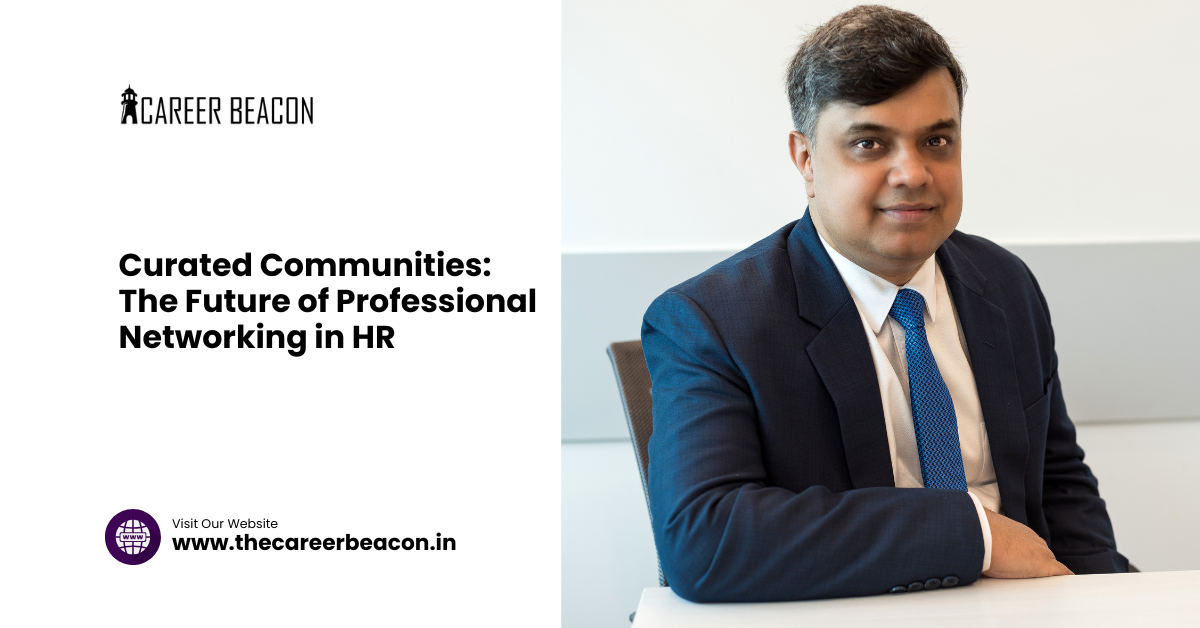
By Surajit Bit, Senior Director – Operations & People Engagement, SHRM India, APAC & MENA
Ask any experienced HR professional where their most valuable ideas came from, and the answer is rarely a presentation slide or a formal report. More often, it comes from a conversation. A quiet discussion with another HR leader who had already dealt with a difficult policy change. A roundtable where someone openly spoke about a failed initiative and what they learned from it. Or a small peer group where people could talk honestly about the pressures of leading people in uncertain times.
Those moments tend to leave a lasting impression. They offer perspective that structured sessions often cannot.
This is exactly why the nature of professional networking in HR is changing. For many years, networking meant attending conferences, meeting a large number of professionals in a short time and exchanging contacts that might be useful later. While those interactions had their value, they were often brief. Conversations stayed on the surface, and meaningful engagement was limited.
But the workplace has become far more complex than it once was. HR leaders today are dealing with rapid technological change, shifting employee expectations and entirely new models of work. Questions around hybrid workplaces, automation, skills development and employee wellbeing are no longer occasional topics. They are daily leadership challenges.
In such a landscape, HR professionals are increasingly seeking spaces where they can go beyond introductions and engage in real dialogue.
This is where curated communities are beginning to reshape professional networking.
Unlike traditional networking forums that gather large and diverse audiences, curated communities bring together smaller groups of professionals who share similar responsibilities, experiences or challenges. Because the group is intentionally formed, the conversations tend to feel more relevant from the start. Instead of broad discussions, participants talk about specific situations they are navigating within their organisations — someone may discuss how their company is handling leadership development during rapid expansion, while another shares how they approached reskilling employees as automation changed job roles.
These exchanges feel less like networking and more like collective problem-solving.
Trust plays a big role in making these communities work. In smaller groups where members interact repeatedly, people become more comfortable speaking openly. They do not feel the need to present polished success stories. Instead, they share what actually happened — including the missteps. For HR leaders, that kind of honesty is invaluable.
Many of the challenges HR teams face today do not come with ready answers. Managing workforce transitions, balancing productivity with wellbeing, or sustaining culture in a hybrid workplace requires thoughtful experimentation. Hearing how others approached similar decisions can offer clarity and reassurance.
Another reason curated communities are gaining importance is that HR leadership can sometimes feel isolating. HR leaders operate at a unique intersection — representing employee concerns while supporting organisational goals. They are expected to guide change while also maintaining trust. Having a network of peers who understand these pressures can make a real difference.
Within curated communities, conversations often extend beyond formal sessions. Members stay connected, exchange insights and continue discussions over time. What begins as a professional network gradually becomes a circle of trusted colleagues. Technology has helped strengthen these communities further — digital platforms now allow members to stay in touch between events, share experiences and discuss emerging workplace issues as they arise.
This continuity helps build stronger professional relationships.
For organisations, encouraging HR leaders to participate in such communities can be extremely valuable. Exposure to diverse perspectives allows leaders to bring fresh thinking back into their organisations, encourages experimentation and helps organisations stay connected with broader workforce developments.
Surajit Bit, who brings over two decades of experience leading cross-functional teams and high-impact HR engagement platforms across India, APAC, and MENA, understands this shift firsthand. In his role as Senior Director – Operations & People Engagement at SHRM India, he has been at the centre of building precisely these kinds of curated learning environments — shaping agendas, forging strategic partnerships, and creating spaces where HR professionals can engage meaningfully beyond the transactional nature of traditional networking.
In many ways, curated communities reflect a broader shift in how professionals learn today. Information is widely available, but practical insight often emerges through conversation. Listening to how another organisation handled a difficult situation can provide lessons that no report can fully capture.
As the world of work continues to evolve, the role of HR leaders will only grow more complex. Navigating this environment requires not only knowledge, but also perspective — and that perspective is most often found in the company of trusted peers.
Curated communities offer exactly that — a space where HR professionals can step away from their daily pressures, reflect with peers and learn from shared experience.
Networking, in this sense, is no longer about collecting contacts. It is about building trusted circles of learning and support. And in a profession centred on people, those connections may well become the most valuable resource HR leaders have.
Surajit Bit is Senior Director – Operations & People Engagement at SHRM India, APAC & MENA. With over two decades of experience in B2B engagement and people leadership, he oversees conferences, curated events, business development, and strategic partnerships that advance the HR profession across India, APAC, and the MENA region.
Disclaimer
Career Beacon has not modified the content except for minor formatting and stylistic changes.