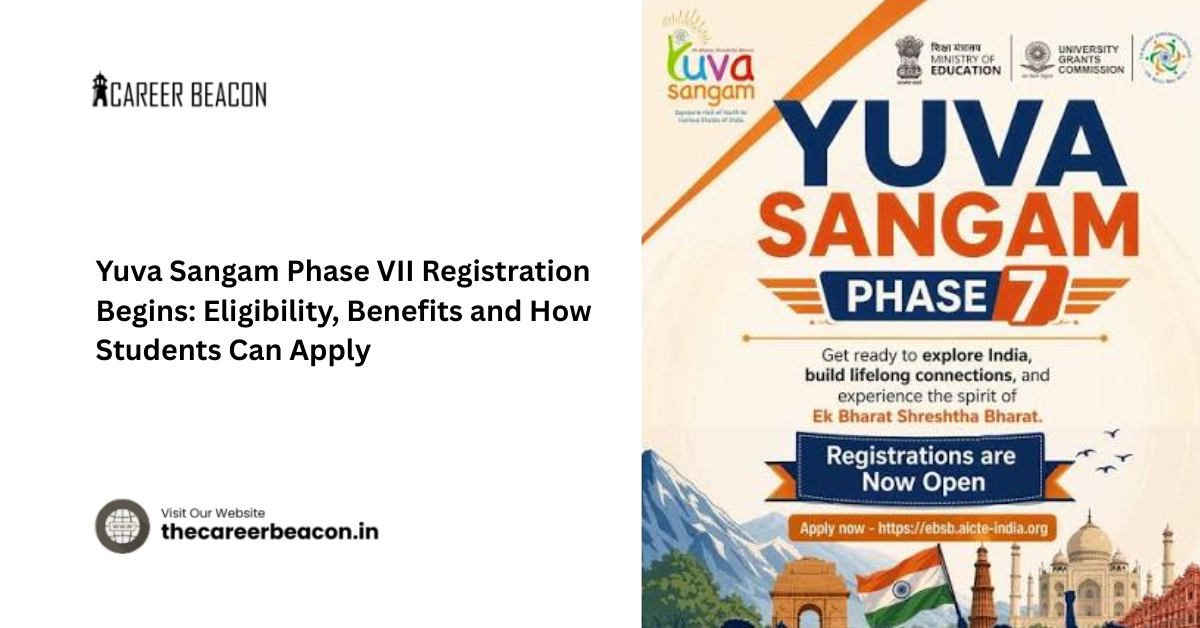
Students and young professionals looking for an opportunity to explore India beyond their home state now have another chance to participate in a national youth exchange programme.
The Ministry of Education has opened Yuva Sangam Phase VII registration under the Ek Bharat Shreshtha Bharat initiative. Applications began on August 4, 2026, and eligible participants can register until August 18, 2026.
The program aims to help young individuals break away from the regular classroom experience. The chosen youth will be taken to a different state or Union Territory where they will meet local tribes, learn about institutes of education, and understand the culture and growth of the area.
For learners, it may be more than just a trip; it may also be a chance to witness how people are studying, working, and living in different areas in India.
What Is Yuva Sangam Phase VII?
Yuva Sangam is a program that brings together young people through exchange programs under the Ministry of Education as part of Ek Bharat Shreshtha Bharat (EBSB) scheme.
The aim of the scheme is to promote youth interaction from across the country and help them understand India’s diverse cultural, linguistic and social aspects.
In Phase VII, 20 Institutions will participate, including IITs, IIMs, Central Universities and NITs, which will be the nodal institutions for the exchange program.
Participants will have educational and cultural tours for five to seven days, which does not include travel days.
Who Can Apply for Yuva Sangam Phase VII?
The program is open to any kind of student without differentiation based on his or her course or university.
As specified by the Ministry of Education, youth aged between 18 and 30 years can enroll in the program. It includes students studying in colleges or universities, those taking part in NSS and NYKS volunteers and those who have started working.
This broad eligibility criterion ensures that the program encompasses both students and youth already working.
What Will Selected Participants Experience?
The Yuva Sangam program is all about gaining real world experience rather than classroom learning.
The participants can learn in the exchange how to visit educational institutions, industries, heritage places as well as innovation ecosystems. They can also meet local communities and learn about regional traditions and daily lives.
The program consists of five major themes called the 5Ps:
- Paryatan deals with tourism and exploration of various Indian places.
- Parampara introduces to the traditions and cultural practices of India.
- Pragati focuses on the concept of development and formation of governance.
- Paraspar Sampark deals with the connection of people.
- Prodyogiki is associated with technology and innovation.
- The concepts of the themes together make the program possible.
Which States and UTs Are Paired in Phase VII?
Many pairings of states and Union Territories have been established as a result of the Phase VII initiative, involving institutions of higher learning.
For instance, Uttar Pradesh has paired with Kerala, Maharashtra with Jammu, Kashmir, and Ladakh, Delhi and Tamil Nadu, Gujarat and Chandigarh, and West Bengal and Uttarakhand.
The remaining pairings consist of Madhya Pradesh with Karnataka, Assam with Telangana, Goa with Mizoram, and Rajasthan with Sikkim.
Through these pairings, different regions are available for experience to participants.
Why Should Students Consider Applying?
The greatest advantage of traveling may not even be traveling.
There are many benefits of living with people from different parts of India, as the young people concerned will be able to communicate better and adapt easily.
Students will be able to understand how different education systems, industries, traditions, and economies work.
Overall, such traveling experience will help students communicate better with representatives of other cultures and languages later on.
How to Register for Yuva Sangam Phase VII
Eligible young people and students can conveniently register on the official portal of Yuva Sangam.
The registration portal can be accessed on the website ebsb.aicte-india.org, and undergraduate applicants must register before the last date of registration at Phase VII on 18th August 2026.
The applicant should ensure that all personal and educational details are filled in carefully before the submission of the application form.
What Makes Yuva Sangam Different?
Laurens Haveman and Paul Maassen contributed equally to this story.
Students in universities often get to know diversity in India through books, documentaries and discussions in the class. However, Yuva Sangam does things differently.
It offers youth the chance to encounter the diversity format face to face.
For instance, a pupil who imdd multiple trips could come to another place, meet local students, check out institutions, see industries and get acquainted with traditions unknown to the student.
Such exposure can contribute to a wider understanding of the country and foster good relations between young people from different parts of the world.
Yuva Sangam and Career Development
Although Yuva Sangam is primarily a youth exchange programme, the experience can also contribute to personal and professional development.
Students can improve their interpersonal skills, become more adaptable and gain confidence while interacting with people from different backgrounds.
Exposure to innovation centres, industries and educational institutions can also give participants a better understanding of career possibilities outside their home region.
However, students should view these as additional benefits rather than treating Yuva Sangam as a conventional internship or job programme.
What Students Should Remember Before Applying
The registration window is short, so interested applicants should avoid waiting until the final day.
Before applying, check whether you meet the age and participant requirements. Keep the necessary information ready and use the official portal rather than relying on unofficial registration links.
Most importantly, read the programme details carefully before submitting the form.
Conclusion
The registration for Yuva Sangam Phase VII provides young people living in India the chance to explore other parts of the country that they may not be familiar with. The candidates will visit educational institutions, industries, monuments, and local communities as part of the programme. The Yuva Sangam also emphasizes hands-on learning while indulging in the cultural richness of the country.
This initiative is aimed at students and young professionals in the age group of 18 to 30 years, to help them make new contacts, explore some unknown places, and appreciate different facets of India’s socio-economic environment.
Candidates may apply till August 18, 2026, and interested and eligible participants must read through the guidelines on the official website to complete the registration process for Yuva Sangam Phase VII.