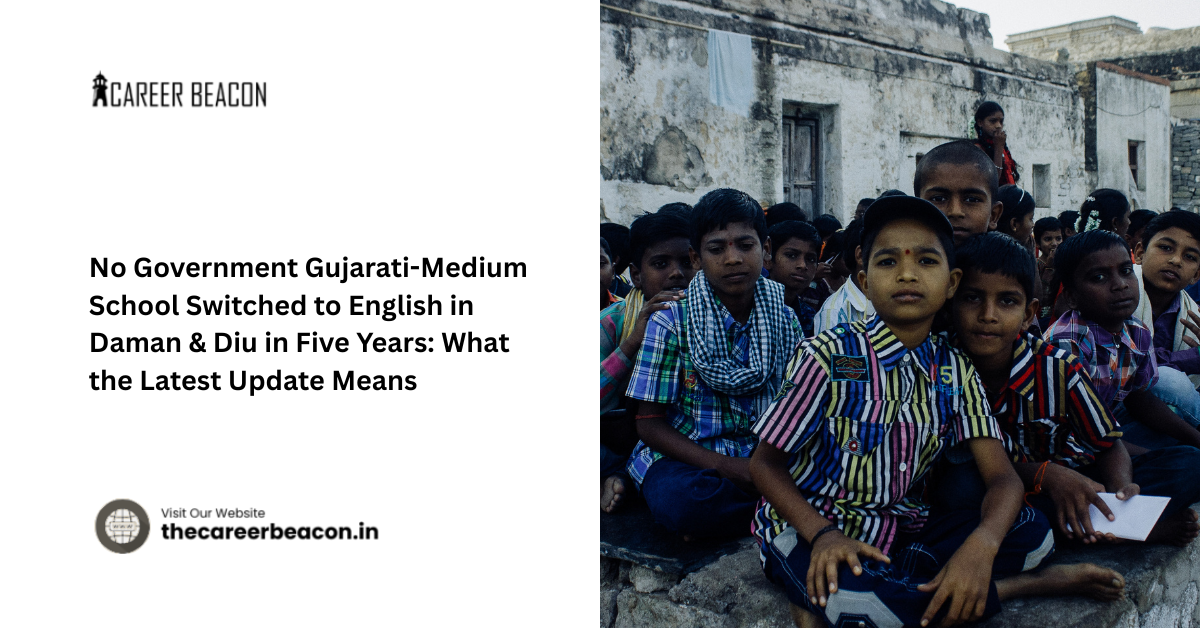
The debate over the medium of instruction in schools continues across India. While many states are introducing English-medium education in government schools, the Union Territory of Dadra and Nagar Haveli and Daman & Diu has taken a different approach.
According to information shared by the administration, no government Gujarati-medium school has been converted into an English-medium school in the last five years. The clarification came in response to questions regarding the language policy followed in government schools.
The announcement has once again highlighted the importance of preserving regional languages while ensuring students receive quality education.
Government Clarifies Its Position
The authorities informed us that within the last five years, government institutions instructing people in Gujarati have operated in accordance with this language. No official orders have been issued to replace Gujarati with English as the means of education.
This statement intends to clarify the fears raised by the community regarding the supposed cancellation of instruction in local languages at public schools.
The officials stated that educational decisions are made in view of the needs of students and current policies.
Why the Issue Matters
The medium of instruction has become an important topic in India’s education system. Parents often prefer English-medium schools because they believe English can improve career opportunities and higher education prospects.
At the same time, many education experts believe that learning in a mother tongue during the early years helps students understand concepts more effectively.
The latest update from Daman and Diu shows that regional-language education continues to remain part of the government’s schooling system.
Growing Demand for English-Medium Education
Across India, demand for English-medium schools has increased significantly over the past decade.
Many families believe that English communication skills improve employment opportunities, especially in sectors such as technology, business, healthcare, and multinational companies.
This growing preference has encouraged several states to introduce English-medium sections in government schools.
However, Daman and Diu have not converted Gujarati-medium government schools during this period.
Importance of Regional Languages
Still, quite a number of households continue to speak Gujarati – among the majority dialects here. The practice of using the mother tongue in the case of youngsters leads to better listening, engagement and participation. According to educationists over the years, learners, who establish basic foundations in studies in their vernacular language will find learning many more other languages easier. Along with learning, this is one more way of safeguarding the local culture and linguistic heritage.
Balancing Language and Career Growth
Although English has become an important language for higher education and global employment, experts believe that the quality of education matters more than the language alone.
Students who study in regional-language schools can still build successful careers if they develop skills such as:
- Communication
- Digital literacy
- Problem-solving
- Critical thinking
- Technical knowledge
Many successful professionals across India completed their early education in regional-language schools before pursuing higher studies in English.
What This Means for Students and Parents
The government’s clarification does not prevent students from learning English. Instead, it confirms that Gujarati-medium schools will continue to operate without being converted into English-medium institutions.
Parents choosing schools should consider several factors beyond language, including:
- Teaching quality
- Academic performance
- Infrastructure
- Skill development opportunities
- Student support services
A strong educational environment often has a greater impact on long-term success than the medium of instruction alone.
The Road Ahead
India’s education system is evolving rapidly under the National Education Policy (NEP), which encourages multilingual learning while promoting foundational education in regional languages.
At the same time, schools continue to strengthen English language education to prepare students for higher education and global careers.
The challenge is to maintain a balance between preserving regional languages and equipping students with the communication skills needed in today’s competitive world.
Conclusion
The confirmation that no government Gujarati-medium school was converted into an English-medium school in Daman and Diu during the last five years reflects the administration’s commitment to maintaining regional-language education.
While English remains an important skill for future careers, the medium of instruction is only one aspect of a student’s educational journey. Strong teaching, practical learning, and skill development continue to play the biggest role in academic and career success.
At TheCareerBeacon, we encourage students and parents to focus on the overall quality of education rather than choosing a school based only on its language of instruction.