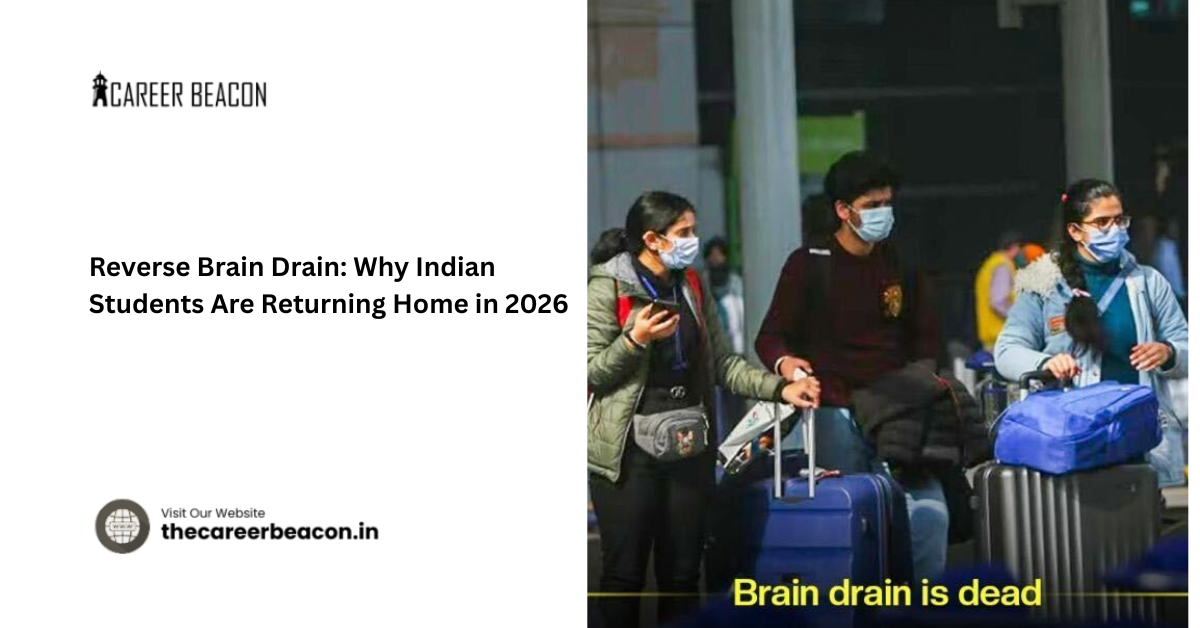
For years, developing countries including India were able to improve their education and career possibilities by sending students abroad. Globalized countries such as Canada, the USA, the UK, or Australia have become popular study locations. However, this pattern seems to be changing and many of those students come back home after their studies. This return of students is known as reverse brain drain and it has become one of the major trends of the career development in 2026.
The main reason for that is the success of the Indian economy, more job opportunities, and development of the startup industry in India.
What Is Reverse Brain Drain?
Reverse brain drain refers to the return of highly skilled professionals and students to their home country after studying or working overseas.
Earlier, many Indian graduates preferred to remain abroad because of better career prospects. Today, India offers competitive salaries, global companies, and exciting startup opportunities, making it an attractive destination for returning talent.
As a result, more students are choosing to begin or continue their careers in India.
Why Are Indian Students Returning Home?
Various factors have played a role in this upsurge.
Enhanced Occupational Prospects in India
India is now among the world’s fastest expanding economies. International firms are increasing their businesses and generating thousands of job opportunities in the fields of artificial intelligence, IT, finance, healthcare, renewable energy, and consulting.
Numerous corporations from abroad now provide the same salaries as employees in other countries. Their return-home graduates benefit by not only having a good career but also being close to their families.
Growing Startup Ecosystem
India is now home to one of the world’s largest startup ecosystems. Cities such as Bengaluru, Hyderabad, Gurugram, Pune, and Mumbai have become innovation hubs.
Students returning from foreign universities often bring international knowledge and fresh ideas. Many of them launch startups or join fast-growing technology companies where they can make a greater impact.
The availability of funding, incubators, and government support has also encouraged entrepreneurship.
Expensive Lifestyle Abroad
The price of living overseas has been rising sharply. Rent, medical care, the cost of commuting, and daily activities have gone up considerably in many nations.
While foreign countries tend to pay a better wage, graduates do not earn significant savings due to the high cost of living.
In contrast, India is proving to be a viable option as a country with cheap expenses and competitive salaries for a number of occupations.
Changing Immigration Policies
Many countries have introduced stricter immigration and work visa rules over the past few years.
Long waiting periods, visa uncertainties, and changing employment policies have made it difficult for international graduates to secure long-term work opportunities.
As a result, many students choose to return to India, where career opportunities continue to grow.
Better Quality of Life
Career decisions are no longer based only on salary.
Many young professionals value work-life balance, family support, cultural familiarity, and personal well-being.
Returning to India allows students to stay close to their loved ones while pursuing meaningful careers.
Flexible work models and hybrid jobs have also made India an attractive place to work.
Industries Benefiting from Reverse Brain Drain
Several industries are actively hiring professionals with international education and experience.
Some of the fastest-growing sectors include:
- Artificial Intelligence and Machine Learning
- Data Science and Analytics
- Software Development
- Financial Services
- Healthcare and Biotechnology
- Electric Vehicles
- Renewable Energy
- Cybersecurity
- Product Management
- Consulting
These industries value global exposure and international education.
Benefits of Reverse Brain Drain for India
The return of talented graduates brings several long-term benefits to the country.
First, it strengthens India’s skilled workforce by introducing new ideas, advanced technologies, and global best practices.
Second, returning professionals contribute to innovation by launching startups, creating employment, and improving productivity.
Finally, international exposure helps Indian companies compete more effectively in global markets.
Reverse brain drain also supports India’s ambition to become a leading innovation and technology hub.
Challenges Returning Students May Face
Although returning home offers many advantages, graduates may also face some challenges.
Some students experience salary differences compared to international jobs. Others need time to adjust to workplace culture or changing industry expectations.
However, India’s rapidly growing economy continues to reduce these challenges by offering better career opportunities every year.
How Students Can Prepare Before Returning
Students planning to return to India should prepare early.
Research the Indian job market before graduation. Build a strong LinkedIn profile and connect with recruiters working in your preferred industry.
Internships, certifications, and industry projects can also improve your chances of securing high-quality job offers.
Developing communication, leadership, and digital skills will further increase employability.
Is Reverse Brain Drain Good for Students?
For many graduates, the answer is yes.
India now provides opportunities that were difficult to find a decade ago. Competitive salaries, global companies, startup growth, and better work-life balance make returning home an attractive option.
The decision ultimately depends on personal career goals, preferred industry, and long-term aspirations.
For students seeking rapid career growth while staying close to family, India offers exciting possibilities.
Future of Reverse Brain Drain in India
Experts believe the reverse brain drain trend will continue over the next decade.
Government initiatives, increasing foreign investment, digital transformation, and rapid technological growth are expected to create millions of high-skilled jobs.
As India’s global influence grows, more students may view returning home as a smart career move rather than a compromise.
This shift could help India become one of the world’s leading destinations for innovation, entrepreneurship, and skilled talent.
Conclusion
The rise of reverse brain drain marks an important change in India’s education and employment landscape. More Indian students are returning home because the country now offers better career opportunities, a thriving startup ecosystem, competitive salaries, and an improved quality of life.
Instead of seeing overseas education as a one-way journey, many graduates now view it as an opportunity to gain global knowledge and apply those skills in India.
For students planning their future, the message is clear: success no longer depends on staying abroad. With the right skills and experience, India offers countless opportunities to build a rewarding career.
Frequently Asked Questions (FAQs)
1. What is reverse brain drain?
Reverse brain drain is the return of skilled professionals and students to their home country after studying or working abroad.
2. Why are Indian students returning to India?
Indian students are returning because of better job opportunities, a growing startup ecosystem, competitive salaries, lower living costs, and changing immigration policies in several countries.
3. Which industries are hiring returning graduates?
Technology, AI, healthcare, finance, renewable energy, cybersecurity, consulting, and product management are among the fastest-growing sectors.
4. Is returning to India a good career decision?
For many students, yes. India’s expanding economy and increasing demand for skilled professionals make it an attractive destination for long-term career growth.
5. Can studying abroad still benefit students who return?
Absolutely. International education provides global exposure, technical expertise, and cross-cultural experience that are highly valued by Indian employers.

 IIT Kharagpur’s Shaurya 8.0: Reckoning of the SeasOctober 11, 2026
 Mohan Babu University Expands into Online Education with Five UG and PG ProgrammesOctober 6, 2026
 Samsung Solve for Tomorrow Selects Top 100 Young Innovators with over 50% Representing Tier 2 & Tier 3 CitiesAugust 2, 2026
 Anant National University’s School of Architecture Receives COA Approval to Expand BArch Intake to 120July 25, 2026