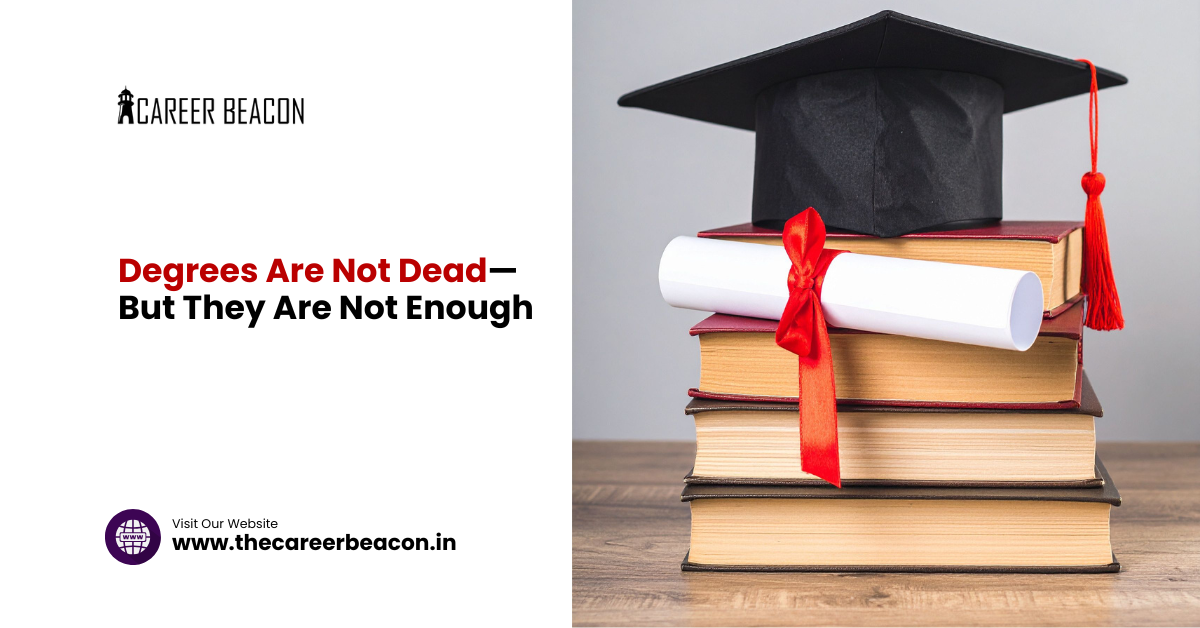
In recent years, a strong narrative has emerged claiming that college degrees are losing relevance. With the rise of skill-based hiring, online certifications, and alternative career paths, many question whether formal education still matters. However, the reality is more nuanced. Degrees are not dead, but in today’s rapidly evolving job market, degrees alone are no longer enough to guarantee career success.
Why Degrees Still Matter
Degrees still play an essential part in education and employment, despite all of the disruption.
A degree serves as the foundation for structured learning and will provide the necessary foundational knowledge along with training that allows one to develop their ability to use higher level of thinking skills and further their professional growth through their education. For the majority of the professions, including but not limited to, Law, Medicine, and Engineering, and Academia, degrees are still essential and the core requirements for a profession and are not completely negotiable.
Employers generally place a high value on the character and discipline of an individual in completing long-term objectives/commitments. The attributes noted above and others mentioned previously are what employers are looking for when hiring entry-level workers.
There is no reason to state that degrees are becoming obsolete due to all of the disruption, because that statement is inaccurate. In fact, degrees are not dead, and still provide the basis for how formal Education today is being provided and continue to be provided.
The Shift in Employer Expectations
Employers want more than just degrees from their job seekers. The job market today is now driven by automation, Artificial Intelligence, and ever-changing business models. Thus, Beyond an employer wanting their prospective employees to have a degree, they also now look for individuals who can use their knowledge in practical circumstances.
Employers now want applicants who possess the skills to solve problems, communicate effectively, adapt to changing circumstances, and have a level of digital proficiency. A graduate with excellent working skills is often more valuable than a graduate with just a high GPA.
This significant transformation in what employers seek is why so many degree holders find themselves unable to acquire jobs, while skilful professionals without traditional bachelor’s degrees can find work easily. This demonstrates a major employment truth that a degree will get you an interview, but having applicable skills will ultimately get you the job!
Why Degrees Alone Are Not Enough
The biggest limitation of degrees is that they often lag behind industry needs. Curricula may not update quickly enough to reflect current technologies or market demands. As a result, graduates may leave college without job-ready skills.
Additionally, careers today are non-linear. Professionals are expected to change roles, industries, and even career paths multiple times. Degrees provide a starting point, but they do not prepare individuals for continuous change unless paired with lifelong learning.
This is where many professionals realize that degrees are only the beginning, not the destination.
The Rise of Skill-Based Learning
The growing emphasis on certifications, micro-credentials, and experiential learning reflects this shift. Online courses, bootcamps, internships, and project-based learning help individuals stay relevant and competitive.
Skill-based learning complements degrees by adding practical expertise. A marketing graduate with data analytics skills or an engineering graduate with AI knowledge becomes far more employable. Employers increasingly prefer candidates who combine academic qualifications with hands-on experience.
In this environment, degrees are valuable, but skills determine employability.
What Students and Professionals Should Do
Instead of choosing between degrees and skills, individuals should focus on combining both. Students should treat degrees as a foundation and actively build skills through internships, projects, certifications, and self-learning.
Professionals, on the other hand, must continuously up-skill or re-skill to keep pace with industry changes. A degree earned years ago needs constant reinforcement through learning and practice.
Career success today belongs to those who learn faster, adapt better, and apply knowledge effectively.
Conclusion
The debate is not about degrees versus skills—it is about relevance. Degrees are not dead, but relying on degrees alone is no longer enough in a competitive and unpredictable job market. Formal education still matters, but it must be supported by practical skills, adaptability, and continuous learning.
In the future of work, those who combine degrees with real-world skills will not just survive—they will thrive.