For a long time, it has been believed that one of the safest methods of guaranteeing success in one’s career is by choosing a reputed university. The reputation of a good university almost guarantees students placements, internships, and entry into business networks.
But the job market is facing a transformation.
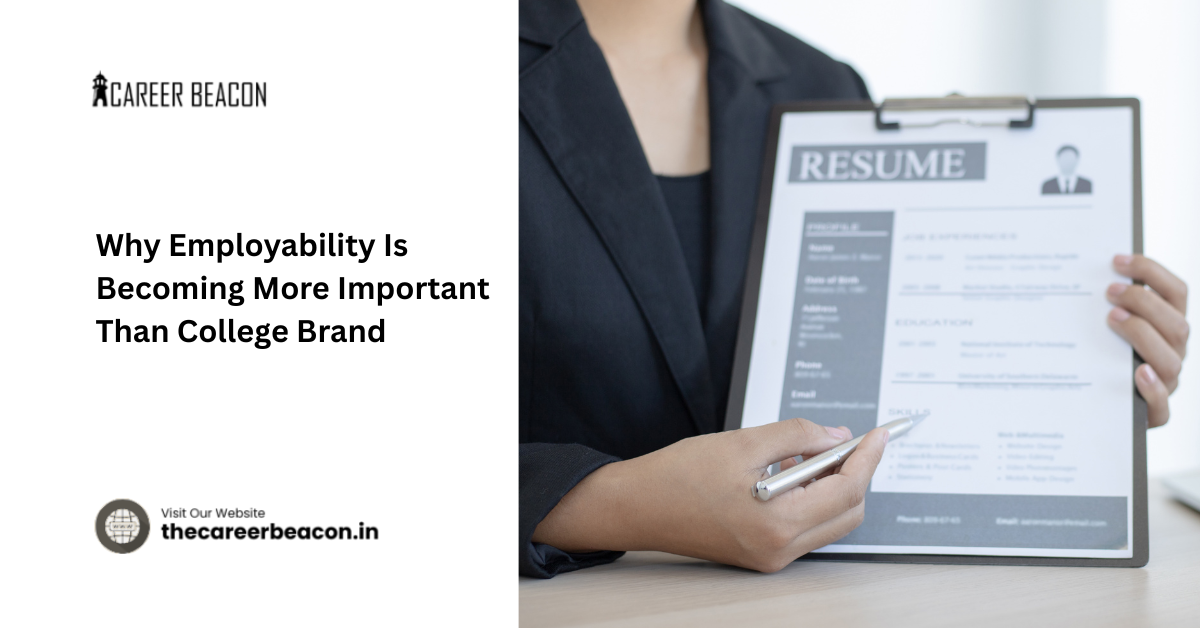
Today employers look beyond the university name. They want to hire people who know how to do the work. This is the reason why employability skills are becoming one of the crucial factors in career success.
While a diploma can grant you access to the labor market, your skills will determine how far you can go.
What Does Employability Mean?
Employability is a person’s capacity to obtain and succeed in a job in addition to developing professionally throughout their career.
It involves far more than knowledge and technical expertise. Communication skills, problem-solving ability, capacity for teamwork, adaptability, and digital skills are also very important.
For students, it means that a degree alone is no longer enough to succeed in today’s labor market.
A graduate with practical skills and readiness for the workplace is in a better position compared to another graduate with just a solid theoretical knowledge.
Why Is College Brand Losing Some of Its Influence?
A well-regarded institution still carries great worth. It can offer enhanced teaching staff, and impressive network of former students, valuable relationships with companies, and connection to employers.
That said, the college name alone is not enough to ensure a person’s successful career.
The prospective employee search process is now focused on skills. Organizations are using various interview methods, assessments, tasks, and internships to evaluate the capabilities of the candidate.
This trend is evident especially in technology-related industries, where particular abilities might become useful for a very short time.
As a result, a student of an average college can compete successfully with graduates of elite institutions if he/she possesses a sound background.
Employers Want Job-Ready Graduates
Firms spend a lot of money and time to train the newly hired employees. Hence, they are looking for candidates that can deliver results in minimum time.
This created a strong need for candidates with ready-to-work skills.
These skills can be, in accordance with the industry, programming, data analysis, digital marketing, business modelling, design, computer security, communication, or project management.
Graduates who acquire these skills before graduation will feel more self-assured when starting their careers.
A Degree Is Still Important
The growing importance of employability does not mean college degrees are becoming useless.
A degree provides academic knowledge and can be essential for many professions. It also demonstrates that a student has completed structured education.
The difference is that employers increasingly want graduates to combine their academic qualifications with practical abilities.
Think of your degree as the foundation.
Your skills, projects and experience are what you build on that foundation.
Skills Can Help Level the Playing Field
The most important benefit of a skills-based job market is that students now have more opportunities to prove themselves.
Universities can create a portfolio through practice projects, internships, freelance work, competitions and certificates.
For instance, a student studying computer science can develop software or contribute to open-source projects. A student studying marketing could run a social media campaign. A finance student could prepare financial plans and make a comparative analysis of company data.
All these examples can indicate the strength of a candidate’s skills.
Internships Are Becoming More Valuable
Internships are an experience that no class can provide, that being the chance to gain real-life experience in the workplace.
Internships teach students how teams operate, how deadlines are respected, and how theory applies to practice.
Even a short internship can help students understand what employers are looking for, as well as allow them to find areas for improvement between now and graduation.
Communication Skills Matter Too
Employability is not limited to technical skills.
A highly skilled candidate may still struggle to get hired if they cannot explain their ideas clearly.
Communication, teamwork and presentation skills are becoming increasingly important because modern workplaces involve collaboration across teams and locations.
Students should therefore work on both technical and soft skills.
Being able to do the work and explain your work is a powerful combination.
AI Is Changing Employer Expectations
Artificial Intelligence is yet another aspect behind the rising significance of employability.
AI tools are transforming the world of work and how companies approach entry-level jobs. Employers are expecting graduates to be proficient in using tools rather than just carrying out monotonous work.
Graduates are not required to be AI engineers.
However, knowing AI tools, digital processes, and responsible technology usage can certainly help them get more jobs.
The most wanted candidates are those who know the industry and can apply new technologies together with their knowledge.
How Students Can Improve Their Employability
There is no need for students to wait until their final year to prepare for the job.
Begin with the identification of the necessary skills needed in your desired career field. After that, practice them with various projects and internships.
Create a resume and a LinkedIn profile. Have a portfolio if the situation allows. Participate in various competitions, workshops, and events.
The most important thing is to keep learning.
College Brand Still Has Advantages
It would be wrong to say that college reputation no longer matters.
A strong college can provide access to experienced professors, better infrastructure, alumni networks and reputed recruiters.
The real change is that college brand is becoming one factor among many, rather than the only factor that determines career success.
A graduate from a top college with outdated skills may struggle, while a graduate from a lesser-known institution who has strong practical skills can stand out.
The ideal combination is therefore a good education plus strong employability.
What Employers May Look for in Future Graduates
The future job market is likely to reward candidates who can combine technical knowledge with human abilities.
Employers may increasingly value:
Problem-solving
Adaptability
Communication
Digital literacy
Critical thinking
Teamwork
Industry knowledge
Practical experience
Students who develop these skills during college can become more confident and competitive when they enter the workforce.
Conclusion
The growing importance of employability does not make college reputation irrelevant. Instead, it reflects a broader change in how companies evaluate graduates.
A college degree can provide knowledge, credibility and opportunities. But practical skills, experience and adaptability help students turn those opportunities into careers.
For students planning their future, the message is simple: do not choose a college only for its name. Choose an education that helps you become capable, confident and job-ready.
At TheCareerBeacon, we believe career success is built by combining education with practical skills, continuous learning and real-world experience.
FAQs
1. Is employability more important than college brand?
Employability and college reputation both matter, but practical skills are becoming increasingly important during recruitment. A strong college name cannot replace the ability to perform a job effectively.
2. Can students from lesser-known colleges get good jobs?
Yes. Students from lesser-known colleges can build successful careers by developing strong technical skills, gaining experience and creating a portfolio that demonstrates their abilities.
3. What are the most important employability skills?
Communication, problem-solving, adaptability, teamwork, digital literacy, critical thinking and practical industry skills are important employability skills.
4. Does college reputation still matter?
Yes. A reputed college can provide better networks, facilities and placement opportunities. However, students still need relevant skills and experience to succeed in the workplace.
5. How can students improve their employability?
Students can improve employability by completing internships, working on practical projects, learning industry-relevant skills, improving communication and staying updated with technology.
6. Why are employers focusing more on skills?
Companies want graduates who can contribute effectively to their teams. Skills-based hiring helps employers evaluate what candidates can actually do rather than relying only on academic qualifications.
7. Can AI affect graduate employability?
Yes. AI is changing many entry-level tasks and workplace processes. Students who understand AI tools and combine them with strong professional skills can be better prepared for the changing job market.
You have not enough Humanizer words left. Upgrade your Surfer plan.