Turning Your Dreams of Flight Into a Career
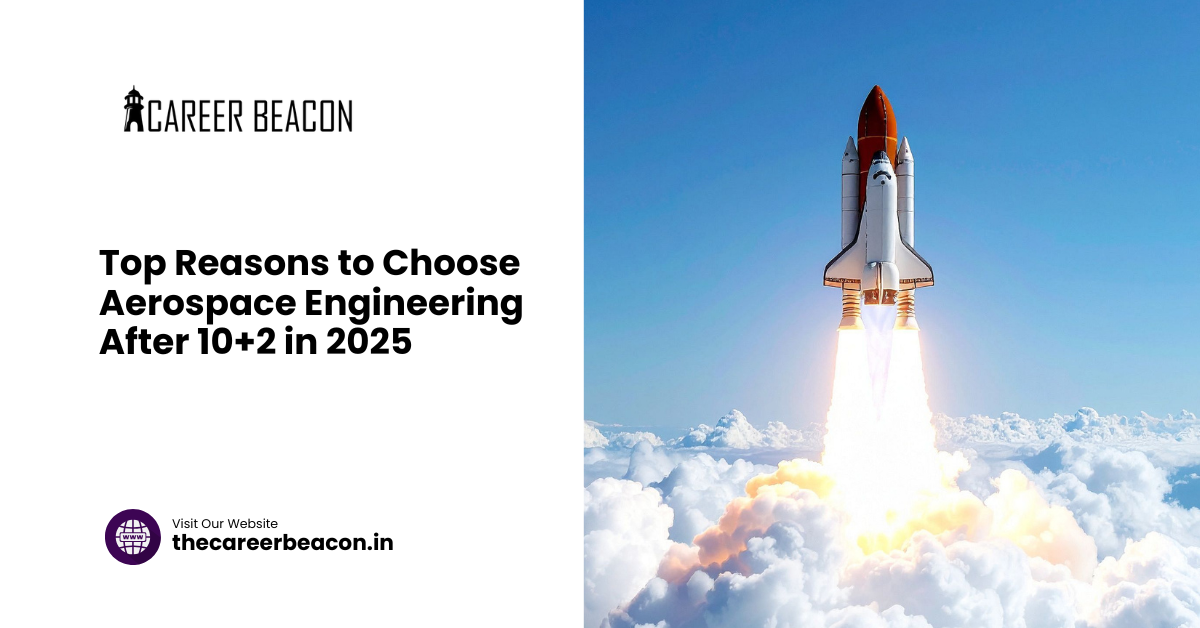
If you’ve seen a rocket take off or an aircraft fly into the atmosphere and thought, “How do they do that?” – Aerospace Engineering may be for you.
As of 2025, Aerospace Engineering is one of the most exciting and future-proof fields of engineering for the 10+2 student. Wth technology advancing quickly, the world working together, and the launch of private space companies, the possibilities of innovation and advancement are endless.
What is Aerospace Engineering?
Aerospace Engineering is a field of engineering that specializes in the design, development, and testing of aircraft and spacecraft.
It is an integration of several disciplines, including mechanical, electronics, and computer science to produce machines that can fly within and out of the Earth’s atmosphere.
Aerospace Engineering is divided into two specializations:
Both fields require creativity, precision, and a strong foundation in science and mathematics — making it ideal for curious and ambitious 10+2 students.
1. A Career That Combines Passion with Innovation
Choosing Aerospace Engineering after 10+2 allows students to turn their fascination with flight and space into a real-world career. You’ll work on cutting-edge technologies — from designing next-generation aircraft to developing reusable rockets and satellite systems.
In 2025, industries are increasingly seeking engineers who can blend creativity with technical excellence, and Aerospace Engineering fits perfectly into that vision.
2. Booming Industry Growth and Global Demand
The global aerospace market is projected to reach over $1 trillion by 2030, driven by advances in defense, commercial aviation, and private space exploration.
India is also witnessing a surge in aerospace projects with ISRO, DRDO, and private startups like Skyroot Aerospace and Agnikul Cosmos making headlines.
This growth translates to strong job demand, both in India and abroad, for skilled aerospace engineers.
3. Prestigious Career Opportunities
Graduates in Aerospace Engineering can explore prestigious roles in top organizations like:
ISRO (Indian Space Research Organisation)
DRDO (Defence Research and Development Organisation)
HAL (Hindustan Aeronautics Limited)
Boeing, Airbus, SpaceX, Rolls-Royce, and NASA
These organizations offer career paths that not only promise financial stability but also the pride of contributing to space exploration, national defense, and global innovation.
4. High Salary and Global Recognition
Aerospace engineers are among the highest-paid professionals in the engineering world.
In India, fresh graduates can earn between ₹6–10 LPA, while experienced professionals working in global aerospace firms can earn ₹20 LPA or more.
The combination of technical expertise, international exposure, and prestige makes this field one of the most rewarding for 10+2 students in 2025.
5. Hands-On Learning and Research Opportunities
Aerospace Engineering isn’t limited to textbooks — it’s a hands-on discipline. Students get the opportunity to work on flight simulators, drone design, rocket prototypes, and space technology experiments.
Top universities and research labs in India and abroad offer internships and projects that allow students to apply real-world engineering principles to challenging problems.
6. Contribution to India’s Space and Defense Programs
India’s space program has become a global symbol of innovation. With successful missions like Chandrayaan-3 and upcoming projects like Gaganyaan, the demand for Aerospace Engineers in both public and private sectors is at an all-time high.
By choosing this field, you don’t just build a career — you contribute to your country’s technological advancement and global recognition.
7. Diverse Career Roles and Specializations
An Aerospace Engineering degree opens doors to multiple career roles such as:
Beyond aviation and space, aerospace engineers are also in demand in automobile, robotics, renewable energy, and AI-driven automation sectors — expanding career flexibility and long-term stability.
8. Study Options and Top Colleges in India
For 10+2 students, India offers several reputed institutions to pursue Aerospace Engineering:
IIT Bombay, IIT Kanpur, IIT Kharagpur
Amity University, Noida
Manipal Institute of Technology (MIT)
Hindustan Institute of Technology & Science, Chennai
Lovely Professional University (LPU), Punjab
These institutes offer world-class faculty, research infrastructure, and placement opportunities with leading aerospace firms.
9. A Future-Focused Field
The future of human mobility and exploration will be shaped by the intersection of aerospace engineering, artificial intelligence, machine learning, green propulsion, and innovative materials in 2025 and beyond.
Aerospace engineers will be essential in creating safer, more intelligent, and more sustainable technology for the coming generation as commercial space flight becomes a reality.
Conclusion: Aim Higher — The Sky Is Not the Limit
If you are a 10+2 student with a passion for science, technology, and innovation, Aerospace Engineering is not just a College degree — it is a journey into the possibilities of human capacity. Whether your aspirations are designing aircraft, planning missions to Mars, or constructing satellites, Aerospace Engineering gives you the wings to achieve all of this.
In 2025 Aerospace Engineering after 10+2 remains one of the most interesting, respected, future-ready career paths – where dreams will always take flight.