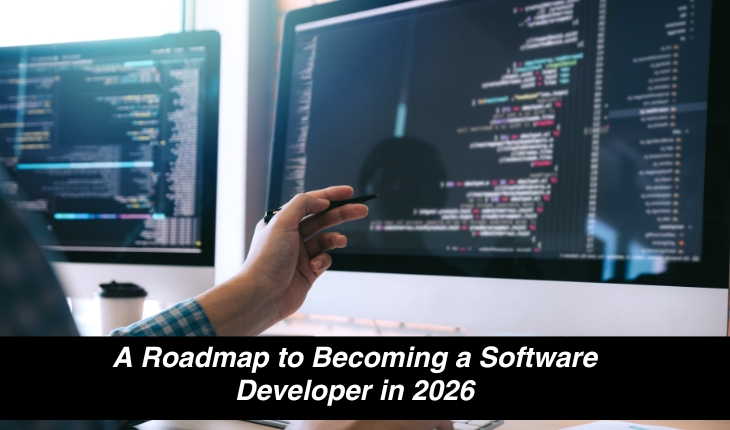
A Roadmap to Becoming a Software Developer in 2026
The software industry has never been more open to newcomers. A decade ago, a computer science degree was essentially the price of entry. These days, developers come from all kinds of backgrounds some hold traditional degrees, others taught themselves, and many simply built things until they were good enough to get hired. In 2026, what actually matters is whether you can solve problems, ship working software, and keep learning.
If you’re figuring out where to begin, here’s a practical breakdown of what to learn, in what order, and why.
Why It’s Still a Smart Career Move
Software is embedded in nearly every industry now. Retail, finance, healthcare, logistics all of them run on digital systems that need to be built and maintained by people who know what they’re doing. That demand isn’t going anywhere, and it stretches across company types and locations.
The appeal is straightforward: the pay is competitive, remote work is genuinely available, and the work itself keeps changing which suits people who get bored doing the same thing for years.
Start With the Fundamentals
Skipping this step is the most common early mistake. Before frameworks, tools, or anything trendy, you need to be comfortable with:
- Variables, data types, and basic data structures
- Loops, conditionals, and functions
- Error handling
- Simple algorithms and logic
Python is an excellent starting point readable syntax, broad real-world use, and a massive community. JavaScript is the other strong choice, especially if web development is your target since it runs in every browser by default.
You can start with Java too. If you pick Java, you should pick basic simple problems to solve. As you progress, you’ll also need to understand how fundamental data structures work internally. Learning concepts such as arrays, linked lists, hash-based collections, HashMap internals helps build a stronger foundation for writing efficient software.
Don’t rush past this. The developers who struggle later almost always have shaky fundamentals.
Learn How the Web Works
Even if you end up specializing in mobile apps or backend systems, web literacy is worth having.
Cover the basics: HTML, CSS, JavaScript, how HTTP works, and what APIs are. Then build a few small things — a personal site, a simple to-do app, a weather widget that pulls from a public API. The goal isn’t perfection; it’s getting comfortable turning an idea into something that actually runs in a browser.
Get Comfortable With Git
Version control is non-negotiable in professional environments. Git is the universal standard, and GitHub is where most of that work lives publicly.
Learn to create repositories, commit changes with clear messages, branch and merge, and resolve conflicts. Employers look at GitHub profiles a few well-organized repositories with real commit history tell a more honest story than most résumés.
Pick a Direction
Once you have the basics down, software development branches into several distinct paths. Trying to do all of them at once is a reliable way to make slow progress.
Front-end – building the interfaces people actually see and interact with. Core tools: HTML, CSS, JavaScript, React, Next.js. Good fit if you care about design and user experience.
Back-end – the systems running underneath: servers, databases, business logic, APIs. Common technologies include Node.js, Python, Java, and SQL databases. If you prefer logic and architecture over visual work, this is the direction.
Full-stack – both sides. More demanding to learn, but companies value it because you can contribute across a project without handoffs.
Mobile – building for phones and tablets. Flutter and React Native cover cross-platform; Swift and Kotlin handle native iOS and Android respectively.
AI/ML development -increasingly relevant in 2026. This area covers intelligent features, data-driven applications, and integrating AI services into products. Even developers who don’t specialize here benefit from understanding the basics.
Learn Databases Early
Almost every real application reads from and writes to a database. Start with SQL – the concepts carry across most systems and the fundamentals don’t go out of date.
PostgreSQL and MySQL are solid relational options to learn on. MongoDB is worth knowing if you encounter document-based storage needs. Understand how to design a basic schema, write queries, and think about data relationships.
Build Real Projects, Not Just Tutorial Clones
Tutorials are useful for getting started. They stop being useful when you just keep doing more tutorials.
At some point, close the course and build something that doesn’t have a step-by-step guide. An expense tracker. A blog with a proper backend. A small e-commerce site. A chat application. Real projects surface problems that tutorials conveniently skip over, and solving those problems is how you actually improve.
Prioritize projects that address a real need even a small one over projects that only exist to demonstrate that you followed a tutorial.
Understand How Software Gets Deployed
Knowing how to build something is only part of the job. You also need a basic grasp of how software gets from your laptop to users.
Learn the concepts: cloud hosting, containers, CI/CD pipelines, environment configuration. You don’t need to become a DevOps specialist, but you should be able to deploy a project and understand what’s happening when you do. AWS, Google Cloud, and Azure are the major platforms; Vercel and Netlify are simpler entry points for web projects.
Use AI Tools – But Don’t Lean on Them
Five years ago, AI coding assistants shaped the current state of the 2026 developer landscape. Now, they are everywhere, and for those who choose to forego using them, will be at a major disadvantage in their productivity.
Use them to accelerate repetitive tasks, gain experience with unfamiliar APIs, and facilitate the creation of boilerplate code. However, you must always evaluate what you receive from them. Most developers that find themselves in trouble do so because they copy and paste the results provided without a thorough understanding. On the other hand, when used as an accelerator for one’s thoughts, as opposed to a replacement for one’s thoughts, many developers will be very successful using these tools.
Build a Strong Portfolio That Demonstrates Real Skills
Certificates tell employers you completed something. Projects tell them what you can do.
Put three to five solid projects on GitHub, write clear README files explaining what each one does and the decisions you made, and if possible, have live demos. Depth matters more than volume one well-built project beats ten abandoned ones every time.
Prepare for the Hiring Process
When you’re ready to start applying, make sure you can handle:
- Common data structure and algorithm questions
- System design discussions at a basic level
- Talking through your own projects clearly
That last one is underestimated. Being able to explain why you made specific technical choices matters more than most candidates expect. Interviewers aren’t just checking what you built -they’re checking how you think.
Mistakes Worth Avoiding
A few patterns reliably slow people down:
- Switching languages every few weeks chasing “the best one”
- Accumulating courses without building anything
- Treating Git as optional until it suddenly isn’t
- Skipping documentation because it seems boring
- Expecting to be job-ready in a couple of months
Progress in this field is real but gradual. An hour of consistent, focused work daily compounds into serious skill over a year. The developers who make it aren’t always the most talented they’re usually the most consistent.
Where to Go From Here
Getting into software development in 2026 is genuinely accessible if you’re willing to put in the work. You don’t need an expensive degree or a perfect background. You need solid fundamentals, real projects, and the patience to keep improving.
Start with the basics, pick a direction once you have them, and build things that challenge you. The first line of code is the hardest part everything after that is just iteration
Read next
 How to Prepare for TCS NQT, Infosys and Wipro Elite 2027October 25, 2026
 AI Engineering Jobs in India: Skills You Need for Rs 1 Crore PayOctober 24, 2026
 Career Skills for Students in 2027: What Employers WantOctober 24, 2026
 Workflow Automation & LLMOps: Automating Routine Business Tasks in 2026October 20, 2026