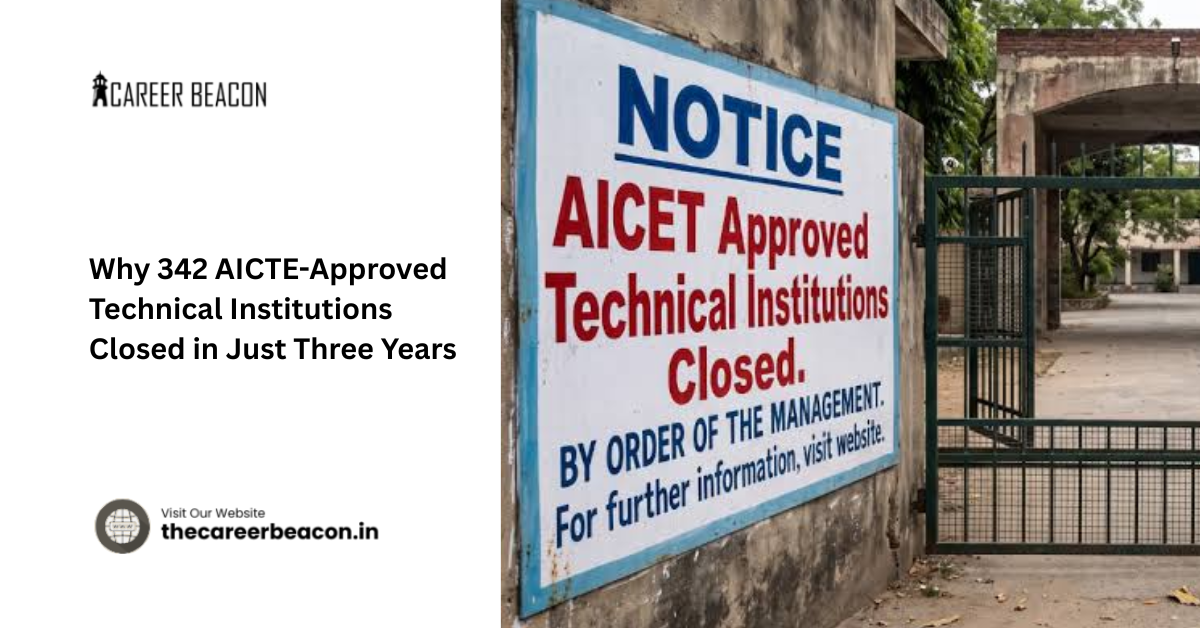
India has long been known for its vast network of engineering and technical colleges. Every year, lakhs of students enroll in these institutions with the dream of building successful careers in engineering, management, pharmacy, and technology. However, a recent trend has raised concerns across the education sector. Over the last three years, 342 AICTE-approved technical institutions closed, leaving students and parents wondering what is happening.
Does this mean technical education is losing its importance? Are fewer students choosing engineering? Or are colleges failing to meet the changing needs of today’s job market?
The answer lies in a combination of factors. In this article, we explain why 342 AICTE-approved technical institutions closed, what it means for students, and how aspiring engineers can make better career decisions.
Understanding the Closure of Technical Institutions
The closure of these institutions does not mean that technical education is becoming less valuable. Instead, it reflects the changing landscape of higher education in India.
Many colleges have struggled to attract students, maintain quality standards, and keep up with modern industry requirements. As a result, several institutions have either voluntarily shut down or lost approval because they could not continue operations.
The focus is now shifting from the number of colleges to the quality of education they provide.
Declining Student Enrolment
One of the biggest reasons behind these closures is the decline in student admissions.
A decade ago, engineering was one of the most preferred career choices in India. Today, students have more options than ever before. Careers in artificial intelligence, digital marketing, design, cybersecurity, finance, healthcare, and entrepreneurship are attracting a growing number of young people.
Many private engineering colleges have found it difficult to fill available seats. When classrooms remain empty year after year, running an institution becomes financially challenging.
Quality Has Become More Important Than Quantity
Students today are more informed than ever before. Before taking admission, they compare placement records, faculty quality, infrastructure, industry exposure, and internship opportunities.
Colleges that fail to provide modern laboratories, experienced faculty, or strong placement support often lose student interest.
This has encouraged students to choose fewer but better institutions instead of simply selecting the nearest engineering college.
Changing Industry Expectations
The job market has changed significantly over the last few years.
Companies no longer hire graduates based only on their degree. They expect practical knowledge, technical skills, communication abilities, and hands-on project experience.
Unfortunately, many institutions continued teaching outdated syllabus without adapting to industry demands.
As employers raised their expectations, students began preferring colleges that offered industry-oriented education.
Rise of Emerging Career Options
Engineering is still an excellent career choice, but it is no longer the only pathway to success.
Students are exploring fields such as:
- Artificial Intelligence
- Data Science
- Product Design
- Digital Marketing
- Cybersecurity
- Animation
- FinTech
- Business Analytics
Many universities have introduced specialized programs in these areas, attracting students who may have otherwise chosen traditional engineering courses.
Financial Challenges for Private Colleges
Running a technical institution requires significant investment.
Colleges need qualified faculty, modern laboratories, updated equipment, libraries, digital infrastructure, and campus facilities.
When admissions decline, fee income also decreases. Many institutions struggle to cover operational expenses, making it difficult to continue functioning.
Some colleges voluntarily close instead of operating with poor resources.
Better Awareness Among Students
Students and parents are making more informed decisions today.
Online reviews, placement reports, accreditation rankings, alumni feedback, and social media discussions provide valuable information before admission.
As a result, institutions with weak academic performance or poor placement records find it increasingly difficult to attract students.
This has naturally increased competition among colleges.
AICTE’s Focus on Quality Education
The All India Council for Technical Education (AICTE) has consistently encouraged institutions to improve academic standards.
Greater emphasis is being placed on:
- Skill-based learning
- Industry collaboration
- Innovation
- Research
- Startup culture
- Outcome-based education
Institutions unable to meet these expectations often struggle to remain competitive.
The objective is not simply to increase the number of colleges but to ensure students receive quality education.
What Does This Mean for Students?
The closure of technical institutions may sound alarming, but it also creates an opportunity for students to choose colleges more carefully.
Instead of focusing only on college names, students should evaluate:
- Placement performance
- Faculty expertise
- Internship opportunities
- Industry partnerships
- Curriculum updates
- Alumni success
- Campus facilities
A college that emphasizes practical learning often provides better career outcomes than one with only a large campus.
Is Engineering Still a Good Career?
Absolutely.
Engineering continues to offer excellent opportunities, especially in emerging technologies.
Professionals skilled in AI, robotics, semiconductor technology, cloud computing, cybersecurity, renewable energy, and data science remain in high demand.
The key difference is that employers now value practical skills as much as academic qualifications.
Students who continuously upgrade their knowledge have strong career prospects.
How Students Should Choose the Right College
Before taking admission, spend time researching your options.
- Visit the campus if possible.
- Speak with current students.
- Review placement statistics.
Check whether companies regularly recruit from the institution.
Also, ensure the college provides practical exposure through internships, industry projects, and innovation labs.
A well-informed decision today can shape your career for years to come.
The Future of Technical Education in India
India’s education system is moving toward quality, innovation, and employability.
Future technical institutions are expected to focus more on interdisciplinary learning, artificial intelligence, automation, sustainability, entrepreneurship, and digital skills.
Instead of increasing the number of engineering colleges, the emphasis is shifting toward producing industry-ready graduates.
This transformation will benefit both students and employers.
Conclusion
The fact that 342 AICTE-approved technical institutions closed in just three years reflects a major shift in India’s higher education landscape. It does not indicate the end of engineering education. Rather, it highlights the growing importance of quality, practical learning, and industry relevance.
For students, this is the right time to make informed choices. Select institutions that focus on skill development, internships, innovation, and strong placement support.
At TheCareerBeacon, we believe the future belongs to students who combine the right education with practical skills. A degree remains important, but continuous learning and adaptability will define long-term career success.
Frequently Asked Questions (FAQs)
1. Why did 342 AICTE-approved technical institutions close?
The main reasons include declining admissions, financial challenges, changing career preferences, and increasing emphasis on quality education.
2. Is engineering losing its demand in India?
No. Engineering remains a popular career choice, but students are now choosing specialized and industry-focused programs.
3. Should students worry about engineering college closures?
Students should not panic. Instead, they should carefully research colleges based on quality, placements, and industry exposure before taking admission.
4. What should students check before choosing a technical college?
Students should review placement records, faculty qualifications, accreditation, internship opportunities, curriculum, and industry collaborations.
5. Which engineering fields have the best future?
Artificial Intelligence, Data Science, Cybersecurity, Robotics, Semiconductor Technology, Renewable Energy, Cloud Computing, and Electronics are among the fastest-growing engineering fields.

 How to Prepare for TCS NQT, Infosys and Wipro Elite 2027October 25, 2026
 AI Engineering Jobs in India: Skills You Need for Rs 1 Crore PayOctober 24, 2026
 Career Skills for Students in 2027: What Employers WantOctober 24, 2026
 Workflow Automation & LLMOps: Automating Routine Business Tasks in 2026October 20, 2026