The growth of technology has led many organizations to ask: how do you replace employees with machines and automated processes? With recent advancements in AI and robotics automation, employees are being asked to learn new job skills that may become obsolete by 2023 and not be needed anymore. Employees will need to learn how to adapt to an increased use of robots in the workplace in order to remain competitive as we continue to modify our economy with the help of AI and robotics.
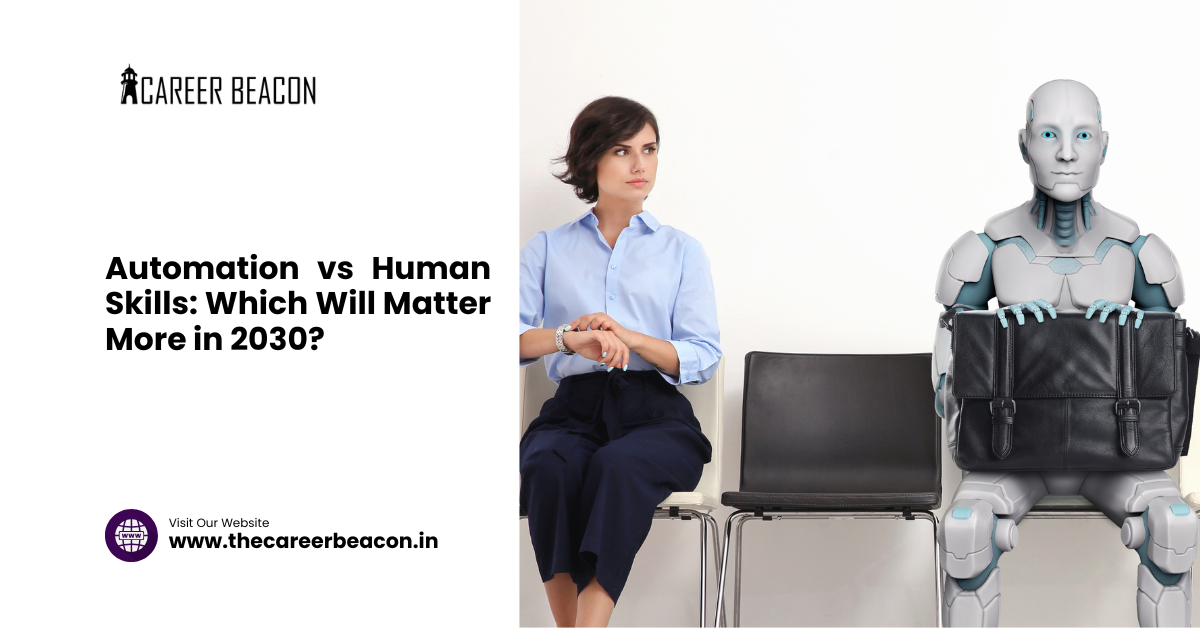
Many professionals and students are wondering “Are automated processes or human skills going to be more valuable in 2030?” The answer is not a clear cut one based on where we’re at today. Humans will still be needed for jobs that require creativity, leadership, communication, and decision-making as automation will take care of repetitive and data-driven tasks. The future workplace will not be a competition between machines (humans and robots); it will be a partnership.
Understanding the Rise of Automation
Automation refers to the use of technology, software, and artificial intelligence to perform tasks with minimal human intervention. Businesses adopt automation to improve efficiency, reduce errors, and increase productivity.
Over the past decade, automation has moved far beyond factory floors. Today, it powers chatbots, recommendation systems, self-checkout machines, predictive analytics tools, and even content generation platforms.
Companies are embracing automation because it allows them to complete routine tasks faster and more accurately. As technology continues to improve, automation is expected to become a standard part of workplaces across industries.
Why Automation Is Growing So Quickly
Several factors are driving the adoption of automation worldwide.
First, businesses want to improve productivity while reducing operational costs. Automated systems can work around the clock without fatigue.
Second, advances in Artificial Intelligence have made automation smarter and more adaptable. Modern systems can process large amounts of information and make decisions based on patterns and data.
Finally, increasing competition is encouraging organizations to embrace technology to stay ahead in the market.
Because of these factors, automation is expected to expand significantly by 2030.
The Strengths of Automation
Automation offers several advantages that make it valuable for businesses.
Machines can process data much faster than humans. They can perform repetitive tasks with high accuracy and consistency. In addition, automated systems can handle large workloads without experiencing fatigue or distractions.
For example, banks use automated systems to detect fraudulent transactions, while hospitals use AI-powered tools to assist in medical diagnosis. These technologies improve efficiency and allow human workers to focus on more complex responsibilities.
However, despite these benefits, automation has limitations.
What Automation Cannot Replace
While automation is great for completing repetitive tasks, it tends to lack a human quality called “empathy.”
Machines have the ability to analyze an enormous amount of data and provide visitor reports and analytics; however, they cannot truly “feel” anything. For example, machines can produce written content; however, machine-generated content generally does not possess “creativity” or the perspective of personal experience. Machines are able to recognize and follow patterns; however, they may struggle in situations where an element of judgment or ethical decision-making is required.
As a result, the value of human skills is becoming more pronounced as technology continues to advance. As a consequence, employers will continue to put more emphasis on skills that are not easily replicated by machines.
Why Human Skills Will Remain Essential
Human skills are the abilities that enable people to communicate, collaborate, innovate, and solve problems. These skills play a critical role in workplaces where teamwork, leadership, and creativity are required.
While automation can improve efficiency, it cannot replace human connection.
For example, a teacher does more than deliver information. A teacher motivates students, understands their challenges, and adapts learning methods based on individual needs. Similarly, a manager does more than assign tasks. Effective leaders inspire teams, resolve conflicts, and build strong workplace cultures.
These responsibilities require emotional intelligence and interpersonal skills that machines cannot fully replicate.
The Human Skills That Will Matter Most by 2030
As automation continues to expand, certain human skills will become even more valuable.
Critical Thinking
Employers need professionals who can analyze situations, evaluate information, and make informed decisions. Critical thinking helps organizations solve complex problems that cannot be addressed through automation alone.
Creativity
Innovation drives business growth. Whether it involves developing new products, creating marketing campaigns, or solving challenges, creativity remains one of the most important human strengths.
Emotional Intelligence
Understanding emotions and building relationships are essential in almost every profession. Employees who can communicate effectively and work well with others will continue to be in demand.
Adaptability
Technology changes rapidly. Professionals who can learn new skills and adapt to changing environments will have a significant advantage.
Leadership
Organizations need leaders who can guide teams, manage change, and make strategic decisions. Leadership remains a distinctly human capability.
Automation vs Human Skills: Which Is More Important?
When comparing Automation vs Human Skills, it becomes clear that both are important.
Automation is excellent at handling repetitive tasks, analyzing large datasets, and improving efficiency. Human skills, on the other hand, are essential for creativity, communication, leadership, and innovation.
The professionals who thrive in 2030 will not be those who compete against automation. Instead, they will be those who learn how to work alongside it.
Businesses increasingly seek employees who can combine technical knowledge with strong human abilities. A marketing professional who understands AI tools and possesses strong communication skills will have a competitive advantage. Similarly, a healthcare professional who uses advanced technology while providing compassionate care will remain highly valuable.
How Students Can Prepare for the Future
Students should focus on developing both technical and human skills.
Learning about Artificial Intelligence, automation tools, and digital technologies can improve employability. At the same time, students should invest in communication, teamwork, problem-solving, and leadership skills.
Participating in projects, internships, and collaborative activities can help students build these abilities. Continuous learning will also become increasingly important as industries evolve.
The goal should not be to choose between automation and human skills. Instead, students should learn how to combine both effectively.
The Future of Work in 2030
The workplace of 2030 will likely look very different from today’s environment. Automation will handle many routine and repetitive tasks, allowing employees to focus on higher-value activities.
Rather than eliminating human workers, technology will change the nature of work. Many jobs will evolve, and entirely new careers will emerge. Professionals who embrace technology while strengthening their human skills will be best positioned for success.
Organizations will continue to need people who can think creatively, lead teams, build relationships, and solve complex problems. These abilities will remain difficult to automate, even as technology becomes more advanced.
Conclusion
As the evolution of advanced technology continues, debates about the conflict between Automation and Human Skills are likely to never stop; however, the future will not favour one or the other in an either/or way. Automation is intended to create more productivity through efficiency (eliminating time spent on repetitive tasks), while the human skills of creativity, communication, emotional intelligence, and such will continue to hold great value in the workplace.
In 2030, the greatest professionals of the future will be those who possess a blend of technical knowledge and distinctly human capabilities. Students who put forth the effort to be proficient in technical as well as interpersonal skills will be more prepared for the circumstances and opportunities within tomorrow’s job market.
At
TheCareerBeacon, we believe that next generation of workers will be adaptive lifelong learners who are willing to explore new ideas while developing their own human capacity – an area where machines cannot compete. As the role ofAutomation in the economy transforms industry after industry; adaptability & continuously improving your skills is critical for success over the course of one’s career.